


 chargement...


Recently, Mediterranean countries have faced an unprecedented wave of forest fires, a distressing scenario increasingly linked to climate change, soaring temperatures, prolonged droughts, and strong winds that transform small blazes into uncontrollable infernos.
This year's fires have swept across nations on both the northern and southern shores, with Spain, Greece, Italy, France, Turkey, Cyprus, Syria, and Lebanon all reporting varying degrees of devastation. The extent of losses, however, differs significantly between countries, highlighting disparities in prevention strategies and emergency-response capabilities.
The comparison between Morocco and Algeria is particularly notable. Despite sharing similar climatic and geographical conditions, the two countries employ distinctly different approaches to managing forest fires, especially in terms of preparation, aerial support, and fire control efficiency.
Morocco: Effective Response System Mitigates Losses Amid Rising Fires
While Morocco has seen an increase in forest fires recently, official data indicates a decrease in total burned area due to enhanced monitoring and swift response systems.
The National Agency for Water and Forests reports about 310 fires from early 2026 to July 20, affecting 1,850 hectares, including 832 hectares of forest and 1,018 hectares of secondary vegetation. Despite a 32% rise in incidents compared to the previous average of 233, the area burned fell by nearly 30%, from 2,660 to 1,850 hectares.
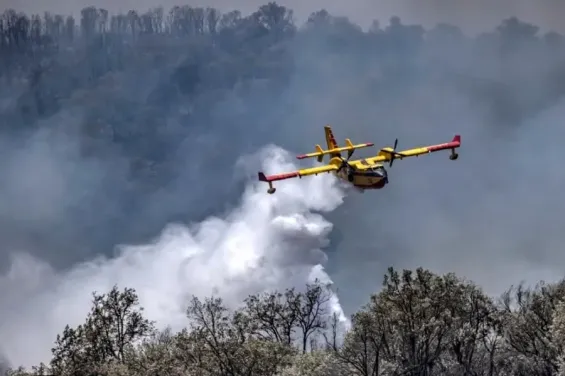
Morocco is equipped with a specialized fleet of eight Canadair firefighting aircraft, bolstering its capability to combat fires in mountainous and forested regions.
Canadair: The Missing Link in Algeria’s Firefighting Arsenal
Canadair planes, crafted in Canada, are renowned for their low-altitude flight capabilities and adeptness in challenging terrains, making them highly effective against forest fires, particularly in mountainous areas.
Many Mediterranean countries use these aircraft: Spain operates 14 planes, while France has 12, allowing them to respond efficiently in multiple areas during peak season.
Despite having the second-largest forest area in the region after Morocco, Algeria faces a starkly different situation. Devastating recurrent fires, like those in summer 2021 that destroyed tens of thousands of hectares and claimed lives, spotlight shortcomings in resource adequacy.
Algeria uses a combination of aerial assets, primarily six Russian Beriev Be-200 aircraft, which, though effective, do not match the Canadairs in handling rugged terrains. These planes' maneuverability and refill speed also fall short. Algeria also deploys army helicopters, which serve as support rather than substitutes for specialized firefighting planes.
A significant flaw in Algeria's strategy is its dependence on leasing foreign aircraft during peak season, a short-term solution that, as Algerian officials acknowledge, can accrue costs akin to purchasing new planes outright.
During the catastrophic summer of 2021, Morocco extended a humanitarian offer to send Canadair aircraft to assist Algeria, a gesture that could have mitigated the disaster. Yet, Algerian authorities rejected this aid, opting instead to rely on distant leased services.





 Fil Info