


 chargement...


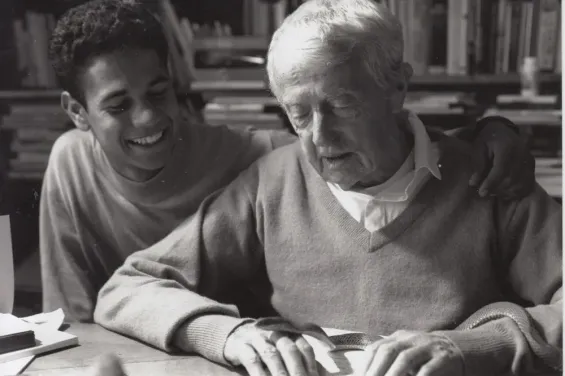
The English Romantic poet and artist William Blake (1757–1827) wrote that «if the doors of perception were cleansed, everything would appear to man as it is, infinite». This visionary line greatly influenced major figures of the Beat Generation, among them Allen Ginsberg, whose literary and intellectual friendship with Paul Bowles (1910–1999) was immortalized in various writings from the first half of the 20th century.
In turn, the American writer and musicologist who made Tangier his home for the final 52 years of his life opened his own «doors of perception» to countless artists and authors. Among them was Karim Debbagh, who discovered cinema, and fell in love with literature, through Bowles, from the very first moment the writer welcomed him into his home, a place he describes as «dark, warm, filled with writing and books everywhere».
Born in Tangier in 1972, the Moroccan filmmaker was only 19 when he met the 82-year-old Paul Bowles. Captivated by words and images, he recorded his conversations with him, filming the captivating universe of the author whose passion for travelogues, novels, poetry, and music had first guided him to Morocco in the 1940s. After Bowles’s death, Debbagh continued filming and preserving this material, which became unique testimonies featuring the writer Mohamed Choukri, the storyteller and painter Mohamed Mrabet, Bowles’s longtime driver Mohamed Temsamani, and Boulaich, who drove him during his final decade.

At the Marrakech International Film Festival (November 28–December 6, 2025), Debbagh presented the world premiere of his documentary Five Eyes, which poetically gathers these testimonies and life stories, reconstructing a history of Paul Bowles told from a Moroccan perspective, far removed from Orientalist clichés.
«Five Eyes» is unprecedented in many ways; it is the first to show images never seen before. Did you want to portray the writer and musicologist differently from the conventional narratives?
Indeed. As you mentioned, the documentary is centered on Paul Bowles’s story and his encounters in Morocco. He is the main character, but his story is told through those close to him. Five Eyes explores how Moroccans who lived and worked with him perceived him. That is a first, and it is what motivated me to create a film shaped entirely through a Moroccan lens.
In Morocco, Paul Bowles’s circle was rich and varied: writers, painters, storytellers, musicians, but also ordinary people who meant a great deal to him. Many lived alongside him for years, accompanying him from his early days in Tangier to the very end.
We’ve often heard about Paul Bowles and Orientalism. Once you decided to make a documentary from your archives, did you aim to reverse these perspectives?
Yes, absolutely. That was not my conscious intention at first, especially since the footage dates back to when I was nineteen. At the time, I simply wanted to document a pivotal encounter at the beginning of my adult life because I sensed it could profoundly shape my path.
Later, when I watched documentaries and films about Paul Bowles, I realized no one ever included the Moroccan perspective. These works showed only European, American, or Western narratives about the writer and composer. Moroccans were often sidelined, or entirely ignored. That struck me deeply.

So I told myself that, as a Moroccan, it was my responsibility to give my fellow citizens a voice in telling his story. And I felt this even more strongly because, after all these documentaries, Bowles is often portrayed as a star. But when you dig deeper, when you study the Beat Generation and Bowles’s life, you discover that his work exists thanks to the time he spent with Moroccans: storytellers like Mohamed Mrabet, writers like Mohamed Choukri, and musicians from Jajouka, Jil Jilala, or the Issaoua. He even recorded traditional Moroccan music between 1949 and 1951.
His life was profoundly shaped by Morocco and by Moroccans. I wanted the film to reflect that. I also wanted Western audiences to hear what Moroccans have to say about Bowles. After 25 years of reflection, I finally decided to make the documentary. And in doing so, I assembled a fully Moroccan technical team.
Tell us about your meeting with German director Frieder Schlaich, who opened the doors to Paul Bowles’s world for you.
I must have been 18 or 19, just beginning my studies in English literature. One day, I was reading Hemingway’s The Old Man and the Sea on Markala beach in Tangier. A German man was taking Polaroid photos of local youths doing acrobatics on the sand. Because of the language barrier, he approached me when he saw my English book.

The photographer turned out to be Frieder Schlaich. That’s where everything began. He told me he was in Tangier to prepare short films inspired by Paul Bowles’s works, and he introduced me to Bowles at his home. Bowles was 82, rarely went out, and people visited him regularly. The atmosphere felt almost sacred.
I felt compelled to return. Something told me that this was important. That’s how I became friends with Paul Bowles, who welcomed me into his world as a young literature student. Thanks to him, many doors opened for me.
The story you tell is also about migration and mobility shaped by literature, mirroring your own path between Morocco and Germany. Has travel influenced your creative process?
Absolutely. My journey stems from meeting Paul Bowles, who immersed me in a universe filled with books, his own, but also Edward Said’s writings, American and British novels, poetry, world literature, and music. These stories guided me toward cinema, where I landed my first job.

Moving between cinema and literature, working, reading, filming, was a defining experience. It allowed me to merge these two worlds, and that greatly shaped my creativity.
As a film producer, mastering both the script you read and the one you bring to life is essential. Creativity is key. Being close to Paul Bowles and coming from a literary background helped me tremendously in my cinematic journey.
Karim Debbagh in «Five Eyes»
In this film, you speak of Paul Bowles as a spiritual father. We see you as a young adult, filmed in 16mm. What did it take to achieve that image quality on screen?
The documentary was shot in two phases. The first was filmed in 1999 on Fujifilm 16mm using an Aaton Super 16mm camera. At that time, digital cinema didn’t exist yet. There was Betacam or Digital Beta, mostly for television. So we had to shoot on 16mm, Super 16mm, and 35mm. With my cameraman friend, we combined these formats, and that’s what you see on screen today.
I’m very happy to have realized this film from that material. Even after 25 years and despite modern cameras like the Alexa or Sony, which are excellent, nothing compares to the texture of 16mm. When you see it on a big screen, you feel it. It gives the film a living, breathing visual dimension.

You sense that the air itself is alive, floating, vibrating. That’s something we rarely perceive in today’s digital images, unless artificially recreated. I feel lucky to have this material as a cinematic treasure.
What about the work on the film’s music?
When you make a documentary about Paul Bowles, you’re also dealing with a composer. Sound becomes just as important as image. Over the seven years I spent with him, I saw everything he created and realized how deeply he was, above all, a musician.
While editing, I wondered how best to accompany these images, how to tell the story of such a major literary and musical figure. Naturally, I turned to Bowles’s own compositions, rich in melody and rhythm, deeply influenced by Moroccan music and musicians.
His classical pieces fit perfectly with the images, transitions, and rhythm of the film, creating a musical language throughout. I also added Moroccan pieces he recorded himself.
The film features previously unheard testimonies, including Mohamed Choukri’s first interview in Darija. Given the complicated relationship between Choukri and Bowles, how did you obtain such an objective interview?
It happened spontaneously. When I met Mohamed Choukri, things unfolded naturally, just like with Paul Bowles. I was immediately struck by his character, his freedom of spirit, and the courage of his words.

I read his books, visited him often, and after making short films about Paul Bowles, I continued working on other documentaries in which Choukri participated. We became very close intellectually. That closeness is what allowed me to set up a camera and speak with him in Darija. When I suggested continuing the interview in dialect, he immediately agreed. I filmed all of them this way.
In the film, you quote Paul Bowles saying, «what drives the world is fear». As a director, do you think we also create out of fear of losing something?
It’s a powerful and very plausible idea. When I heard it from Paul Bowles, and later from Mohamed Choukri, I thought long and hard about it. It became, and remains, a truth to me.
Yes, I believe we are driven by fear, and many things happen because we feel it. It may sound philosophical, but it’s profoundly realistic. Fear exists in every artist, and it drives us to create.


 Fil Info