


 chargement...


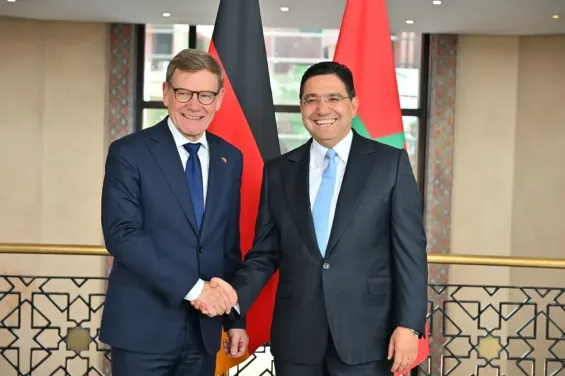
During his inaugural visit to Morocco, Germany's Foreign Minister Johann Wadephul was warmly received in Rabat this Thursday by Morocco's Foreign Minister, Nasser Bourita. Bourita described the visit as «important» for multiple reasons, notably as it coincides with the 70th anniversary of diplomatic relations between the two nations. This milestone is being marked by the second session of their comprehensive Strategic Dialogue.
In this context, both countries expressed a mutual ambition to elevate their cooperation into a genuine partnership that spans various sectors and is future-oriented, enriched by a longstanding history of exchanges since the first bilateral agreement was signed in 1890. Johann Wadephul also underscored the significance and consistency of Morocco's autonomy initiative for the Sahara, which is central to Berlin's stance on the issue.
A Shared Interest in Regional Peace
Germany aims to act on this principle, both politically and economically. In this regard, Berlin views Morocco's autonomy plan as a «serious and credible basis for negotiations» to achieve a just, lasting, and mutually acceptable resolution. It also voiced support for the efforts of the United Nations Secretary-General and his personal envoy.

Following Johann Wadephul's discussions with the Moroccan Minister of Foreign Affairs, African Cooperation, and Moroccans Residing Abroad, a press briefing clarified that both parties share similar positions on regional stability, particularly concerning the Middle East, Mali, and the Sahel.
In this regard, Johann Wadephul «welcomed» the «broad consensus already reached on many points» in the bilateral strategic dialogue, encompassing politics, peace, security, economy, and investment, all crucial areas for strengthening relations between Rabat and Berlin.
«Morocco is a key country for Germany on the African continent. We share common interests and maintain excellent economic relations (…) More than 300 German companies invest here and benefit (…) we want to continue to exploit this potential.»
A Rich Economic Partnership with Its Investors
Nasser Bourita echoed this sentiment, emphasizing that the cooperation dynamic with Germany spans numerous sectors, with Berlin being «a major economic player in Morocco».

«Tourism, a driving force of the national economy, has seen significant development in recent years. Today, we are approaching one million German tourists in the country, an increase of 11% in one year. The meeting also focused on the development of these areas and their impact on economic relations.»
«New areas of cooperation are also opening up, in renewable energies and digital transition, as well as other sectors where German companies are firmly established in Morocco,» noted the head of Moroccan diplomacy, adding that discussions also centered on «how to promote these possibilities to the private sector, to collaborate around these opportunities».
The minister affirmed that the legal framework allows for strengthening this dynamic in «almost all areas of activity for investors in Morocco». Both parties maintain that this cooperation benefits from the principles of «mutual respect and responsibility at the regional level», as well as shared commitments towards a qualitative evolution of these relations.




 Fil Info