


 chargement...


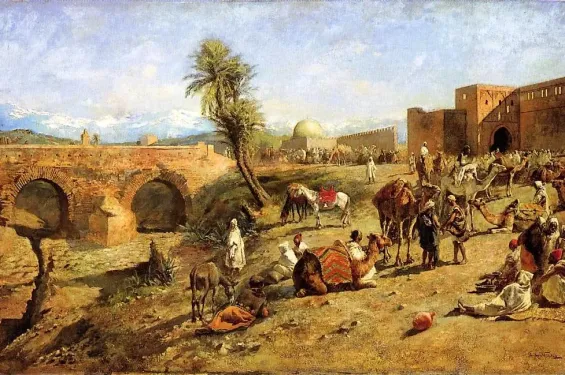
In Morocco, many traditional jobs and professions are gradually disappearing, from the guerrab, the traditional water seller, to the neffar, who announced suhoor during Ramadan. Others, once considered essential, have already vanished, like the zettat.
Born from a specific political and societal context in Morocco, the profession disappeared once it was no longer needed. A zettat, or azettat in Tamazight, was a man, or several men known as zettata, who escorted travelers and caravans across tribes and territories throughout the country, especially in less secure regions where central authority was weaker, in exchange of money.
The practice became so common in 19th-century Morocco that it appeared in the writings of French explorer, geographer, and priest Charles de Foucauld, who himself relied on zettats during his travels, particularly in bled essiba, regions not fully subdued to the Makhzen.
Travelers, Foucauld explained, would ask a member of the tribe they were crossing for anaïa, or «protection», to guide them safely to a designated place. Once a price was negotiated, the zettat would personally escort the traveler, or entrust the journey to «one or several men», until reaching the agreed destination.
The journey itself functioned through a chain of protectors. As Foucauld wrote, travelers moved from one escort to another: «a new anaïa, a new zettat, and so forth. You pass from hand to hand in this way until you arrive at your destination». Depending on the danger of the road, the escort could consist of a single man or several zettats.
More Than an Escort
But anaïa was more than a response to insecurity. Foucauld noted that it also served as a source of revenue for tribes and powerful families. American anthropologist Clifford Geertz later argued that the zettat was not merely an armed escort, but part of a broader system of protection, honor, and negotiated authority that made movement and trade possible in large parts of pre-colonial Morocco.
Geertz describes the zettata system as forming part of «a whole complex of moral rituals, customs with the force of law and the weight of sanctity». In Amazigh societies, protection was deeply personal and symbolic. A powerful man publicly attached his reputation and honor to the traveler placed under his care. Geertz summarizes this logic through a striking formula: «This man is mine; harm him and you insult me; insult me and you will answer for it», he writes in Suq: Geertz on the Market.
The traveler, in a sense, temporarily borrowed the identity and social standing of his protector. The relationship itself was highly ritualized. According to Geertz, caravan leaders and zettats exchanged turbans, cloaks, saddle covers, or pieces of cloth «to create a symbolic fusion of their public selves». These ceremonies often took place publicly in markets before local notables and tribal figures.
The zettata system also became essential to commerce. Jewish merchants traveling through rural Morocco often relied on similar agreements known as mezrag, through which tribal leaders guaranteed both their safety and their commercial activities in villages and markets across the countryside.
Feared as Much as Trusted
Yet the zettat remained an ambiguous figure, feared as much as he was trusted. While many were driven by «a feeling of honor» and sought to preserve a strong reputation by protecting their protégés, even «risk[ing] their lives to defend yours», others abused the power they held over travelers.
Foucauld warned that «in places where there is no law nor justice system of any sort, where each man depends only upon himself, zettats can pillage and butcher, on the way, travelers they had promised to defend». He even advised travelers to choose their protector «with the greatest prudence» and to investigate carefully a man’s reputation before placing themselves under his anaïa. Some escorts, he wrote, betrayed travelers by robbing them, while others secretly arranged attacks by larger groups, abandoned caravans after receiving payment, or demanded more money midway through the journey.
Once an essential part of travel across Morocco, the zettat gradually disappeared when the profession was no longer needed, leaving behind a lasting legacy and offering a glimpse into a world long forgotten.





 Fil Info