


 chargement...


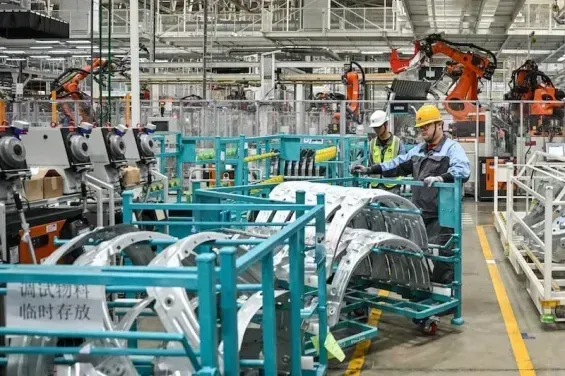
China’s push to establish an industrial base in Morocco is raising growing concerns within the European Union, where officials fear that billions of dollars in planned Chinese investments could turn the kingdom into a platform for exporting state-subsidized products to Europe, potentially flooding the market and putting pressure on local industries.
Maroš Šefčovič, the European Commissioner for Trade, told the Financial Times that Chinese investments in Morocco reflect Beijing’s efforts to address excess domestic production capacity by channeling exports to Europe through third countries. He described the trend as «a very big problem for the European economy».
Amid escalating trade tensions, the European Union has stepped up its trade defense measures against China and what it views as attempts to circumvent customs duties. Last year, the European Commission concluded that aluminum wheels exported from Morocco had benefited from unfair subsidies granted by both Rabat and Beijing under the framework of the Belt and Road Initiative.
European officials acknowledge, however, that distinguishing between legitimate Chinese industrial cooperation in Morocco and efforts to bypass European tariffs is not always straightforward. The EU has already imposed tariffs of up to 45% on Chinese electric vehicles.
Chinese investors argue that Morocco has become a strategic link in Europe’s automotive supply chains, making any future protectionist measures more complex.
Junji Cai, project manager at Chinese braking systems manufacturer APG, said the company’s planned $70 million factory in the Tanger Tech industrial zone will rely on local labor and materials, while incorporating Chinese technology and components. He argued that cooperation between European, Moroccan and Chinese companies creates mutual benefits and provides competitively priced products for European manufacturers.
APG is expected to join around ten other Chinese firms in the industrial zone. Sentury Tire has already started operating its plant there, while BTR New Material Group, the world’s largest supplier of battery anode materials, is building a new facility in the same zone.
Morocco rejects the accusations
Other major Chinese investments in Morocco include a $1.3 billion battery gigafactory being developed by Gotion High-tech in Kenitra, in which Germany’s Volkswagen Group holds a 25% stake. The project is the first of its kind in the Middle East and North Africa.
Mehdi Iraqi, chairman of the Morocco-China Business Council, told the Financial Times that since the Covid-19 pandemic, Morocco has been receiving two to three delegations of prospective Chinese investors every week.
Morocco’s appeal to foreign investors is based on a range of advantages, including a five-year tax exemption, a young workforce, access to renewable energy that can help reduce costs associated with the EU’s carbon border tax, and preferential access to a market of around 2.5 billion consumers through nearly 50 free trade agreements, including those with the European Union and the United States.
Moroccan officials reject suggestions that the kingdom’s special economic zones could serve as a back door for Chinese industrial overcapacity into Europe. Yassine Lahyani, head of emerging industries and other sectors at the Moroccan Investment and Export Development Agency (AMDIE), said Morocco could become «one of the European Union’s best industrial partners».
He described cooperation between Morocco and the EU as a mutually beneficial opportunity and stressed that Chinese investors operating in the kingdom must comply with rules of origin, which require products to undergo sufficient industrial transformation in Morocco in order to qualify for customs exemptions when exported to the European Union.





 Fil Info