


 chargement...


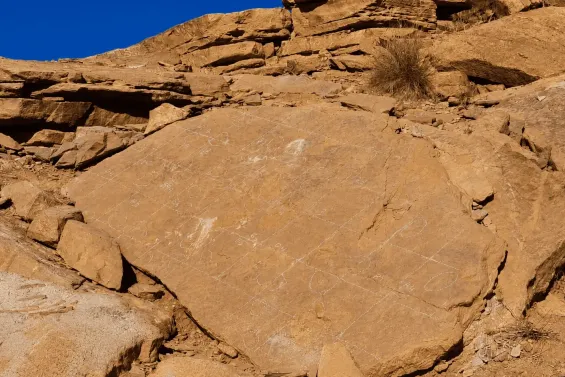
A rock slab preserving some of Morocco’s rarest pterosaur footprints has disappeared from the Mibladen site near Midelt, dealing a major blow to the country’s paleontological heritage.
The slab, which contained both footprints and handprints left by prehistoric flying reptiles, was cut and looted in May, researchers involved in documenting the site told Yabiladi on Monday.
The theft marks the second attack on the site in less than two years.
«Last year, the rock slab containing these footprints was cut in two. Someone removed one section and took it away», said Abdelouahed Lagnaoui, a professor of paleontology at Hassan I University and a contributor to a study on the site published this month.
When he returned to the site on May 8, he discovered that the remaining section had also disappeared.
 The first looting, the slab cut in two with a rock saw. / Ph. Moussa Masour
«It is not a small slab; it measures around three meters by one to two meters», he said, dismissing the possibility of simple vandalism. According to Lagnaoui, the slab was deliberately «cut with a rock saw and stolen».
The disappearance was also confirmed by Moussa Masrour, a professor of biostratigraphy, ichnology and geological heritage and one of the lead authors of the study.
According to Masrour, the Mibladen site had long been known to researchers but had never been thoroughly studied until a Moroccan-Spanish team conducted detailed fieldwork there.
The first alarm was raised when researchers from Moulay Ismail University in Meknes discovered that half of the fossil-bearing slab had been cut away. Masrour publicly called for the remaining section to be protected.
«I denounced the act on social media in the hope that the authorities would intervene and protect the remaining half. Unfortunately, nothing was done», he said.
A rare scientific treasure
For Lagnaoui, the site was particularly significant because it preserved both footprints and handprints left by pterosaurs, flying reptiles that lived during the age of dinosaurs. «Pterosaur remains are rare in Africa», he said.
According to the researchers, the site was one of the very few locations in Africa known to contain pterosaur footprints and the first in Morocco where a trackway preserving both handprints and footprints had been documented in detail.
In Morocco, similar traces have only been identified at a handful of locations, they noted, including Agadir and Tagragra. The Mibladen discovery was especially important because it belonged to a group of pterosaur footprints first identified in Morocco. «In fact, the species itself was named after Morocco: Agadirichnus», Lagnaoui said.

Calls for urgent protection
For both researchers, the disappearance of the slab should serve as a wake-up call. They argue that the site is far from an isolated case and warn that other paleontological and archaeological sites could face a similar fate if preventive measures are not taken.
«We are speaking out so that the same thing does not happen elsewhere, whether at paleontological or archaeological sites», Masrour said, stressing that remote and isolated heritage sites require special protection.
Both researchers stressed that the responsibility for protecting such sites ultimately lies with public authorities. «We can demonstrate the importance and value of these sites, but we cannot protect them ourselves», Lagnaoui said. «It is up to the authorities to act on the information and research we provide.»
More than a scientific loss
The researchers argue that the disappearance of sites such as Mibladen represents not only a scientific loss but also a missed opportunity for local development.
Lagnaoui recalled that publicizing the discovery attracted visitors to the region and generated interest in its geological heritage.
Masrour pointed to the example of Anza, near Agadir, where awareness campaigns helped local residents become active guardians of a site containing dinosaur footprints.
Today, he said, local residents help protect the site, which attracts visitors and supports nearby businesses. «People living near these sites need to understand that they can benefit from preserving them rather than vandalizing or selling pieces of their heritage», he explained.
For Lagnaoui, geological heritage deserves the same level of respect as Morocco’s historic monuments. «Destroying geological heritage is no different from destroying a kasbah», he said.
The two scientists also called for a more proactive preservation strategy. Masrour urged authorities to identify and inventory vulnerable sites before they become targets for looting or vandalism.
«Protective measures should be taken before such unfortunate incidents occur, not afterward», he concluded.





 Fil Info