


 chargement...


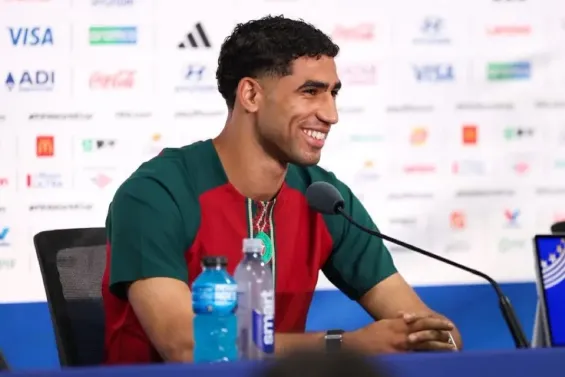
«He is a Moroccan machine. Having a player like that is like having three players.»
When Luis Enrique describes Achraf Hakimi in those terms, there is little room for debate. A starter under every coach for nearly a decade, the Atlas Lions captain has established himself as one of the few players around whom Morocco has built its footballing identity. Tireless down the flank, decisive on the biggest occasions and indispensable for both club and country, the PSG full-back now embodies the most ambitious face of Moroccan football.
When Hakimi made his first appearances for Morocco in 2016, he was just 17 years old. At the time, the Atlas Lions were still searching for their place among world football's elite. A decade later, everything has changed. Morocco are World Cup semi-finalists, credible contenders on the international stage, hosts of the 2025 Africa Cup of Nations and future co-hosts of the 2030 World Cup. Connecting those two eras is one constant: Achraf Hakimi.
Generations have come and gone, coaches have changed and several senior figures have moved on, but he has remained. First a teenage prodigy, then an undisputed starter, the Lions' captain is now performing at a level that almost defies explanation.
Developed at Real Madrid, unleashed at Borussia Dortmund, crowned Italian champion with Inter Milan and now a star at Paris Saint-Germain, Hakimi has climbed every rung of the ladder without ever looking back. Yet it is in the Moroccan shirt that he has truly stepped into the spotlight.
For years, the Atlas Lions built their attacking play around creators such as Hakim Ziyech and Sofiane Boufal, players capable of changing a match with a single touch of genius. Hakimi's influence is different. It does not stem from a moment of inspiration or an unpredictable final pass, but from his ability to relentlessly drive the game forward.
A full-back on the team sheet, a winger when he surges forward and, at times, even a playmaker during certain phases of play, he has become one of Morocco's most potent weapons. His runs, movement and ability to break lines are now woven into the very fabric of the national team's identity.
In Qatar, his bursts down the flank played a pivotal role in Morocco's historic run to the World Cup semi-finals. Four years later, they remain one of the team's greatest strengths.
A captain unlike any other
Neither the loudest voice in the dressing room nor the most demonstrative figure on the pitch, Hakimi does not fit the traditional image of an authoritarian captain. His leadership is expressed differently: through his performances and by setting an example. Off the field, he maintains a close bond with his teammates and remains one of the group's most approachable figures.
His appearances on social media, his exchanges with teammates and several viral interviews reveal a player comfortable with self-deprecating humour. His sometimes hesitant attempts at darija, his jokes with teammates and his spontaneous celebrations have helped shape the image of a superstar who never takes himself too seriously.
That lightness stands in stark contrast to the weight of expectation he carries. For several years now, Hakimi has borne a significant share of an entire nation's hopes. Every training camp, every major tournament and every ambition attached to the national team runs, in part, through him.
At 27, he is no longer simply the talented youngster who emerged from Real Madrid's academy, nor merely the PSG star admired across Europe. He has become the face of a golden generation and one of the defining symbols of modern Moroccan football, a captain capable of making an entire dressing room laugh minutes before kick-off, then sprinting the length of the pitch moments later to change the course of a match.

In the end, behind the «machine» described by Luis Enrique lies something perhaps even more valuable: a leader who never forgets to enjoy the game.




 Fil Info