


 chargement...


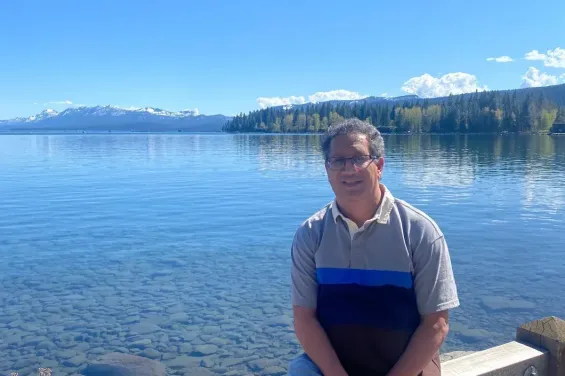
Tracking down Mohamed Ahammam during his visits to Morocco can be an adventure. His niece Chaimae jokes, «If you’re waiting for Pipo at a restaurant at 8 p.m., I’d suggest ordering without him. He’s likely somewhere on the roads, rediscovering a Morocco he knows intimately.»
Pipo—that’s what everyone in the family calls him. «When I was a kid, I only knew my uncle by his nickname, without ever knowing his real first name,» his 24-year-old niece laughs. The nickname fits perfectly. From Washington to Casablanca, Akdim to Africa and Asia, Mohamed Ahammam is always on the move. Beneath that energy is the story of a child from the Atlas Mountains who became an international expert, never losing his deep Moroccan roots.
From Tinghir to Agadir: Lessons in Resilience
Mohamed Ahammam was born and raised in the Tinghir region of southeastern Morocco, nestled in the heart of the Atlas Mountains. Coming from a modest family, he grew up in a setting where education was more than just an academic pursuit—it was a lifeline. At just 13, he had to leave his village to pursue secondary education, facing a harsh transition under challenging conditions.

Far from home and on exhausting commutes, he quickly learned independence. «I spent hours on the road to get to school. We’re talking about a four-hour journey for 100 kilometers of track.» This reality shaped his character: resilience, discipline, endurance—qualities that would define his future.
After earning his science baccalaureate with honors, he enrolled at the University of Agadir, earning a degree in physics. For his niece, this period is revealing. «His journey shaped him. Leaving Tinghir allowed him to build his career. Pipo always taught me to seize opportunities, step out of my comfort zone, and take risks.»
«My Travels Have Taught Me to Remain Humble»
Mohamed’s career began in Morocco, working in rural development. He soon joined international NGOs like Helen Keller International, focusing on access to water, health, and rural development. He dedicated nearly six years to these causes before moving on to Burkina Faso for another four years.
Fieldwork became his greatest teacher, building recognized expertise in rural resource management and socio-economic development. In 2007, a new chapter began in the United States.
Settling in Washington, D.C., with his Filipino wife, Mohamed resumed his studies while advancing his career in international development. This new stage deepened his understanding of diverse systems, cultures, and development visions.

His expertise expanded over the years. Education, health, climate, economy, and sustainable development—Mohamed’s field of action became global. Invited to numerous conferences and strategic gatherings, he is acclaimed for designing sustainable and equitable development strategies. «I have worked across all sectors essential to human beings, contributing to their development worldwide.»
What truly sets Mohamed apart is his ground-level perspective. After working in Africa, Asia, Europe, and Latin America, he feels enriched, yet aware of the limits of a single viewpoint. For him, development requires humility and constant self-reflection. «My travels have taught me to remain humble. My perspective changes with each move. But respect is paramount: recognizing diverse cultures and customs and valuing coexistence.»
To him, no strategy makes sense without understanding local realities, cultures, and community needs. «Fieldwork» remains the foundation of everything.
«Morocco is My Identity»
Despite the years and distance, Mohamed has never severed ties with Morocco. On the contrary, since 2007, he sees himself as an «ambassador of Morocco» in both professional and personal spheres. This bond is expressed through a profound loyalty to Akdim, his native village. His niece talks about it fondly. «Akdim means everything to him.»
She recounts a familiar scene. «Last time we worked in Casablanca, I barely saw him. Once work was done, he was already on the road. Whenever he’s in Morocco, he always returns to the village.» It’s an irresistible pull, well known to his family and friends. «He returns to Morocco and it’s like he discovers it anew each time,» Chaimae laughs.

Mohamed is passing on this heritage to his son, making sure to take him to the village regularly, teaching him the mother tongue, and ensuring he understands his roots. «I take him to the village at least once a year. I want him to speak my native language and understand where I come from.» He has not forgotten the 13-year-old boy who crossed the mountains for education, nor the sacrifices of a generation that left their homeland to succeed.
«Morocco is my identity. No matter where I go, I’ll always be that Moroccan from the High Atlas. Mohamed Ahammam is Morocco,» he states.



 Fil Info