


 chargement...


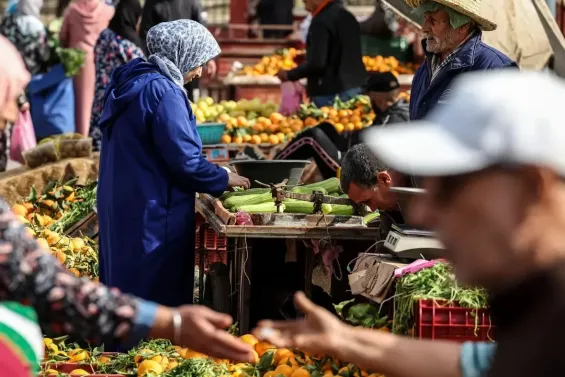
A report by the Omega Center for Economic and Geopolitical Studies has highlighted a widening gap between Morocco's economic growth and its impact on household finances, arguing that rising GDP is not translating into higher incomes, greater savings, or a tangible improvement in living standards.
The report, obtained by Yabiladi, says that a comparison of the 2024 regional accounts with the findings of the household economic conditions survey for the second quarter of 2026 shows that the wealth generated by the economy continues to be distributed unevenly across sectors, regions and social groups.
According to the center, Morocco's economy grew by 4.4% in real terms in 2024, while GDP at current prices reached approximately 1,614.6 billion dirhams. However, the report notes that this growth was unevenly distributed across the country's regions.
It argues that the pace of economic growth does not necessarily reflect its quality or its capacity to create stable jobs. Growth driven by construction and public works tends to be cyclical, while agriculture and fishing remain highly exposed to climate conditions and fluctuations in external markets. By contrast, growth led by diversified industrial and service sectors is considered more likely to improve productivity and generate sustainable employment.
Casablanca-Settat, Rabat-Salé-Kénitra and Tangier-Tétouan-Al Hoceima together accounted for 58.4% of Morocco's GDP, while Drâa-Tafilalet and the country's three southern regions contributed just 7.8%, despite some of them recording relatively strong growth.
The report warns that such concentration leaves the national economy heavily dependent on a handful of economic hubs. Any disruption affecting Casablanca's industrial base, the Rabat-Kénitra services corridor or Tangier's logistics sector could therefore have repercussions across the country.
Growth households do not feel
Although Morocco's GDP per capita averaged 43,891 dirhams in 2024, the report stresses that this figure does not reflect households' actual income, as a significant share of the added value is absorbed by corporate profits, export-oriented activities or reinvested outside the local economy.
The gap is reflected in household sentiment. During the second quarter of 2026, 78.3% of households said their living standards had deteriorated over the previous 12 months, compared with only 5.2% who reported an improvement. More than half (51%) also expected conditions to worsen further over the coming year.
Households' ability to save also remained under pressure. The savings balance stood at minus 80.9 points, with only 2.6% of households able to save, while 38.7% said they had to dip into their savings or borrow money to cover daily expenses. Meanwhile, 65.3% considered the period unfavorable for purchasing durable goods, and 57.2% expected unemployment to increase.
The report attributes this disconnect to the fact that GDP growth does not automatically translate into higher disposable household income. It also notes that several fast-growing sectors are capital-intensive rather than labor-intensive, limiting their impact on employment and wages. In addition, the 8.7% increase in GDP at current prices, compared with real growth of 4.4%, partly reflects inflation rather than a genuine expansion in economic activity.
It further explains that higher household spending does not necessarily indicate stronger purchasing power. Rising costs for housing, transport and services, combined with dwindling savings and greater reliance on borrowing, allow consumption to continue temporarily while households' financial resilience gradually weakens.
To better assess how economic growth benefits citizens, the center recommends complementing GDP with regional indicators measuring disposable income, savings, household debt, housing and transport costs, median wages and the share of stable employment.
The report concludes that the key measure of future economic performance should not be each region's contribution to GDP alone, but how much of the wealth created is converted into wages, jobs, skills, local businesses, quality public services and a genuine improvement in households' ability to save and their overall standard of living.





 Fil Info