


 chargement...


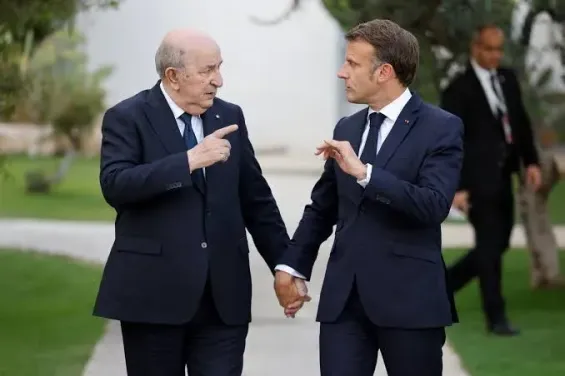
The investigative program Complément d'enquête, aired on France 2 on Thursday evening, has sparked irritation within the Algerian news agency APS, after examining the deep crisis straining relations between Algiers and Paris through a series of testimonies.
According to Chems-Eddine Hafiz, Rector of the Grand Mosque of Paris, French President Emmanuel Macron’s recognition of Moroccan sovereignty over Western Sahara, formalized in a letter dated July 30, 2024 and addressed to King Mohammed VI, constituted a genuine «rupture» in relations between the French head of state and his Algerian counterpart, Abdelmadjid Tebboune.
⚡️According to the rector of the Grand Mosque of Paris, the French and Algerian heads of state were «on very familiar terms». Until President Tebboune felt betrayed. In the Western Sahara issue, France has chosen the rival brother, Morocco. Thus, it has disavowed Algiers. pic.twitter.com/iBXFgZk9xk
— Complément d'enquête (@Cdenquete) January 22, 2026
The former director of Tebboune’s electoral campaign in France during the September 2024 Algerian presidential election further claimed that the Algerian president had explicitly warned Emmanuel Macron during a meeting on the sidelines of the G20 summit in Bari in June 2024. «If you do it, it will be over between us», Tebboune is said to have told Macron, according to the former lawyer of the Polisario Front before the Court of Justice of the European Union (CJEU).
However, France’s ambassador to Algiers, Stéphane Ramatet, offers a markedly different account. He stressed that the decision to recognize Moroccan sovereignty over the Sahara was the result of deliberations that lasted «weeks and weeks». «The decision was taken in full knowledge of the facts and with complete awareness of its consequences, both for relations with Morocco and with Algeria», the diplomat explained.
Algiers chose to ignore the signals sent by Séjourné
Prior to the formal decision of July 30, 2024, Paris had already sent clear signals. During his first official visit to Morocco on February 26, 2024, then French Minister of Foreign Affairs Stéphane Séjourné praised Morocco’s development projects in its southern provinces and reaffirmed his government’s commitment to support Rabat’s efforts.
These messages were nevertheless ignored by Algiers, which appeared to deliberately downplay them. Some Algerian media even welcomed the visit, claiming that «in Rabat, the French foreign minister was disciplined in his movements and restrained in his statements, leaving no room for media manipulation of the visit’s outcomes».
The signals became even clearer in April 2024 with what was described as a «recognition of Morocco’s economic sovereignty» over the Sahara. This was embodied in the French government’s commitment to finance a 3-gigawatt electricity cable linking Casablanca to Dakhla, an announcement made on April 26, 2024 by then Minister of the Economy and Finance Bruno Le Maire.
Taken together, these steps gradually paved the way for the major political decision formalized on July 30, 2024.
Today, Algeria appears to be seeking to repair its strained relationship with France, relegating the Western Sahara dispute to the background. This shift is notably reflected in concessions made on January 11 regarding the return of Algerian nationals subject to deportation orders from France, as well as in the removal, within the law criminalizing colonization adopted yesterday by the upper house, of provisions deemed likely to offend French authorities.




 Fil Info