


 chargement...


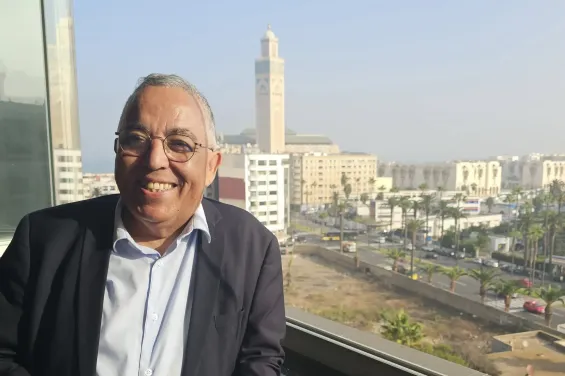
For the second election in a row, Salaheddine El Manouzi will not run as the Socialist Union of Popular Forces (USFP) lead candidate in the Casablanca-Anfa constituency. Ahead of the September 2026 elections, he says he learned of his exclusion «through social media» a few days ago, after the party opted instead for Latifa Cherif, currently an MP elected on Oujda’s regional list. Following his sidelining in the 2021 elections, this latest decision once again sets aside a candidate with deep family and activist roots in the constituency.
Interviewed alongside three other party members, Salaheddine El Manouzi told Yabiladi he was asked «how many votes [he] thought [he] could “guarantee”» in the 2026 elections. «It is a loaded question, and my answer was clear. I do not have my fellow citizens’ votes in my pocket. I stressed that the constituency was historically Ittihadi and traditionally left-wing, that the USFP had long managed the municipality of Sidi Belyout, and that the votes that carried the party came from local residents», he told us.
«The second question was also loaded. It concerned my financial means. As the party’s candidate, I said I was counting on the party’s support and that I would do my best to run a campaign that was both successful and transparent», El Manouzi added. He also questioned the composition of the committee responsible for selecting candidates. «It was chaired by a member who is himself a candidate in a constituency where several other contenders are competing», he said.
An ouster despite deep local roots
El Manouzi’s proposed candidacy was built in part around representing Moroccans living abroad, as he is based in Amiens, France. «That is what I highlighted, especially since the party could benefit from a sixfold increase in public funding in such a case, while putting forward a candidate active in civil society, rooted in the constituency and carrying a long political and activist legacy», he explained.
Born and raised in Casablanca’s medina, El Manouzi is the son of the late Haj Ali El Manouzi, a historic figure of the Moroccan resistance and a prominent human rights activist. He is also the brother of Houcine El Manouzi, a trade unionist and member of the National Union of Popular Forces who disappeared in 1972. He says his decision to seek office was a continuation of his family’s long-standing commitment to public life.
For him, Casablanca-Anfa was an «obvious choice», given his ties to the neighborhood where he grew up, his network within civil society, support from local traders, and «the financial incentive provided by electoral law in the event of a candidacy by a Moroccan living abroad». «In 2021, the party’s first secretary overlooked these assets in order to favor a local notable», El Manouzi recalled.
In 2026, he believes his exclusion comes «amid deep disagreements over the management of the party, respect for its democratic principles and the preservation of its historic and activist legacy». According to him, the reasons behind the decision «mainly lie in the persistence of the memory of the arrest of Socialist Youth activists in 1977, opposition to a fourth term for the party president, and condemnation of the circumstances surrounding the election of the First Secretary at the 12th Congress, deemed undemocratic».
Internal party management under scrutiny
Among the other reasons for his sidelining, El Manouzi cites «the rejection of a management style based on the concentration of power and the personalization of political decision-making», as well as «questions raised over the use of public funds allocated to the party» and «calls for an extraordinary congress to launch the reforms needed to restructure the party politically and organizationally».
The activist argues that «beyond personal considerations, this situation raises fundamental questions about respect for the USFP’s founding values, including internal democracy, pluralism, transparency, accountability and loyalty to the memory of the activists who shaped the party’s history».
In this regard, he points to «the responsibility of political parties, which show neither independence nor political will, and whose leaders sometimes focus on their personal interests, going so far as to claim that Moroccans living abroad want to take their place».





 Fil Info