


 chargement...


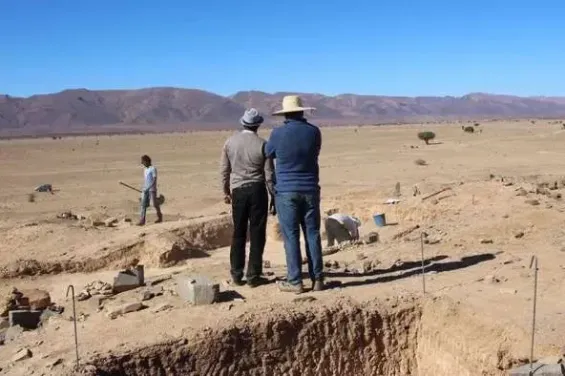
The ancient city of «Tamedoult», nestled along the Draa Valley's banks about 13 kilometers southeast of Aqqa in Tata Province, has always been recognized in historical references as a fortified stronghold and a crucial hub for agriculture and trans-Saharan commerce. However, a groundbreaking archaeological study published in the journal Historical Metallurgy has unveiled another facet of the city: its role as one of the most sophisticated centers for metal production and processing in medieval northwestern Africa.
This research, spearheaded by an international team from the Cyprus Institute, the British Museum, and the University of East Anglia, in collaboration with Morocco's National Institute of Archaeology and Heritage Sciences, is rooted in extensive excavations and field surveys initiated in 2018 under the «Jbel Bani Archaeological Project.» Rigorous laboratory analyses of industrial waste revealed that Tamedoult, founded in the ninth century by the Idrisids, boasted comprehensive production chains for silver, lead, copper, and brass. This finding transforms the city's image from a mere trading post into a full-fledged industrial capital.

While historical accounts offer scant details about Tamedoult's decline, radiocarbon dating of charred date pits recently unearthed from the site and nearby «Telrisht» confirms ongoing settlement and activity between 1233 and 1430 CE. Coins from the Almoravid and Almohad periods further support this continuity.
Advanced Techniques in Silver and Brass Production
The study's foremost scientific contribution lies in addressing a historical void: written records never mentioned copper, iron, or brass production in Tamedoult. Yet, chemical and microscopic analyses revealed that the city's craftsmen adeptly utilized local geology rich in lead, zinc, and copper sulfides.
Artisans in Tamedoult mastered two advanced industrial processes. The first was lead and silver production, evidenced by remains of smelting furnaces, lead-rich powdered ores, and slag with high lead oxide concentrations. Significantly, rare cupellation hearth fragments were found—an indication of the thermochemical separation technique for extracting silver from lead at temperatures between 950 and 1,000 degrees Celsius.
.jpg)
Analyzing the hearth fragments' dimensions, researchers deduced that these processes were industrially scaled, producing approximately 500-gram silver ingots per cycle, before casting them into clay molds for silver pellets or balls.
The second discovery was the complete brass-making cycle through the cementation technique. In a workshop atop the fortified hill, the team found air-blowing tubes, copper-smelting furnace remnants, zinc carbonate particles, and numerous crucibles made from aluminum-rich refractory clay and charcoal dust. This mix created a reducing environment, preventing zinc vapor oxidation and allowing it to merge with molten copper, forming brass. V-shaped or trapezoidal molds were also discovered, crafted for elongated ingots intended for export.
.jpg)
Strategic Spatial Organization
The study sheds light on Tamedoult's strategic spatial organization, demonstrating that industrial operations were aligned according to strategic, security, and environmental priorities. Heavy, polluting primary smelting of copper and lead was conducted outside city walls, in the western and eastern valleys. Meanwhile, high-value activities such as silver refinement, brass production, and ingot creation took place within protected workshops in the citadel and the hilltop residential areas—ensuring official control and reducing theft and smuggling.
Interestingly, researchers noted a complete absence of iron smelting or blacksmithing waste, suggesting either the unexplored excavation areas or a deliberate policy by local leaders to conserve scarce resources like firewood for high-value industries, delegating ironworking to nearby regions.





 Fil Info