


 chargement...


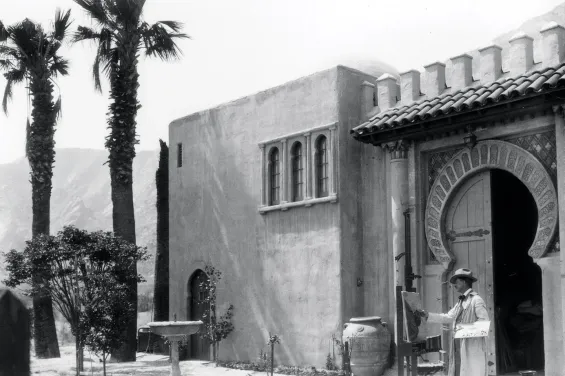
Long before Palm Springs became synonymous with Hollywood glamour and luxury resorts, one of its most unusual landmarks was born from a Scottish artist's love affair with Morocco.
In 1924, painter Gordon Coutts arrived in the California desert after spending several years in Tangier with his wife, Gertrude Russell. He had originally intended to stay only briefly before returning to Morocco, but the dry climate offered relief from the bronchial illness that had begun to affect his health. Instead of going back, he decided to bring Morocco with him.
Born in Aberdeen in 1880, Coutts studied art in Glasgow, London and Paris before earning an international reputation for his portraits, desert landscapes and scenes inspired by Morocco. His works were exhibited at London's Royal Academy and the Paris Salon, while museums in Britain, Australia and Morocco acquired his paintings. During his years in Tangier, he painted Arab notables and immersed himself in the city's architecture, atmosphere and way of life.

Arches, a dome, and a piece of Morocco
When he settled at the foot of California's San Jacinto Mountains, Coutts built a Moorish villa unlike anything the region had seen. He named it Dar Marroc, although Palm Springs residents quickly nicknamed it «Coutts Castle». With its towers, domes and imposing silhouette, the residence resembled a piece of a Moroccan kasbah rising from the California desert.
The villa was conceived as a recreation of Tangier. Thick white stucco walls enclosed intimate courtyards shaded by olive, citrus and palm trees. Moorish arches, domes and keyhole-shaped windows framed tiled fountains, while carved wooden doors opened onto rooms decorated with objects collected during the artist's travels. Bougainvillea and oleander spilled across the gardens, creating what contemporaries described as «a little bit of Tangier dropped onto the Palm Springs landscape».

At its heart stood a large artist's studio flooded with northern light, where Coutts continued painting until declining health forced him to slow down. The villa soon became a gathering place for artists, writers and celebrities. Among its visitors were Grant Wood, the American painter best known for American Gothic; renowned Scottish portrait artist Sir John Lavery; Hollywood stars Rudolph Valentino and Errol Flynn; while local tradition even holds that British statesman and painter Winston Churchill, himself a great admirer of Morocco, once painted in the upstairs studio.
Coutts died in 1937, only thirteen years after completing the villa. Over the following decades, Dar Marroc passed through several owners and survived periods of neglect before being carefully restored.
Today, it forms part of Korakia Pensione, where much of the original Moroccan architecture, including its courtyards, arches, fountains and carved details, has been preserved, offering a rare reminder of how one artist carried a piece of Morocco across the Atlantic and into the California desert.




 Fil Info