


 chargement...


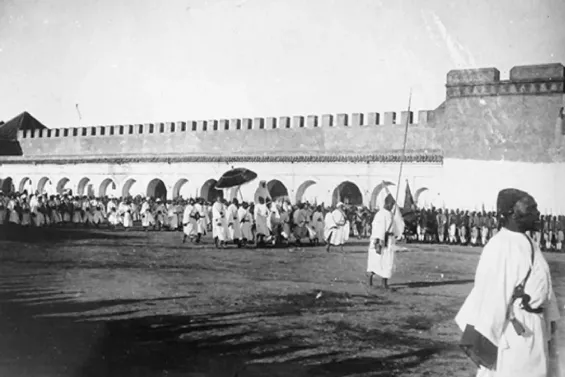
As Moroccans prepare for Eid al-Adha, one of the kingdom’s most enduring royal rituals remains the monarch’s ceremonial procession from the palace to the musalla for Eid prayer. More than a century ago, this same tradition became the setting for a historic first: the first officially sanctioned public photographs taken during an Eid al-Kabir celebration in Morocco.
At the end of March 1901, in Fez, Sultan Moulay Abdelaziz asked photographers, spearheaded by French photographer Gabriel Veyre, to document the Eid ceremonies and the review of royal troops accompanying the celebration.
The ceremony itself followed a carefully choreographed royal ritual. «The ‘Id al-Kabir celebration began with the sultan wearing his traditional white robe on horseback, with the royal parasol, parading from the palace to the musalla», writes historian Patricia Goldsworthy in Colonial Negatives, citing Veyre’s account.
«A Scandal Among the Troops!»
Held outside the city walls, the musalla, the open-air prayer ground «where Eid prayers and the sacrifice ceremony were held», attracted a particularly mixed audience. The crowd, Goldsworthy notes, was so «diverse», that it included non-Muslims and Europeans. What made the 1901 Eid celebration unprecedented, however, was the presence of cameras.
 1901 Eid al Adha celebration in Fez. / Ph. Gabriel Veyre
«It’s the first time in Moroccan history that photographers have been authorized to bring out their cameras», Veyre later recalled. For many Moroccans present, the scene was deeply unsettling. «What a scandal this created among the troops!» he wrote, explaining that soldiers insulted the photographers despite the sultan’s direct approval of their presence. «In spite of these menaces, the sultan's orders were respected», Veyre wrote.
The introduction of photography into the Eid ceremonies was not accidental. Fascinated by new technologies, Moulay Abdelaziz had already developed a strong personal interest in photography years earlier. Before cameras appeared during the 1901 Eid al-Adha celebrations, photography had largely remained confined within palace walls.
 Gabriel Veyre photographed by Sultan Moulay Abdelaziz.
Gabriel Veyre himself was not just the sultan’s photographer. He became part of the royal court, teaching the sultan photography and taking photographs inside the palace long before allowing cameras outside its walls. Moulay Abdelaziz also experimented with the camera personally and even photographed Veyre himself.
Eid al-Adha as a Display of Royal Authority
Choosing Eid al-Adha for this unprecedented public use of photography, however, was not simply about a fascination with the medium. Goldsworthy describes the move as a display of power.
«Such public displays of pageantry in Morocco demonstrated the authority of the sultan in addition to celebrating the nation’s Muslim heritage», she writes. Eid al-Kabir itself carried deep political significance in Morocco. According to Goldsworthy, the ceremony represented «a significant display and validation of the sultan’s authority» during a period marked by internal unrest and growing European influence.
Goldsworthy further argues that «the sultan’s use of photography offers a new interpretation of the sultan in the pre-Protectorate era». It offers a glimpse into the sultan’s fusion of «European technology and Moroccan tradition».
Rather than passively accepting European influence, Moulay Abdelaziz «acted as an arbiter between what he believed to be an inevitable European penetration and Moroccan tradition as he selectively integrated European influence and new technologies into the country».
By moving photography from the private confines of the palace into the heart of a royal Eid procession, the sultan transformed the camera into both a political and ceremonial tool. In doing so, the 1901 Eid al-Adha celebrations became a rare moment where monarchy, ritual, politics, and modern technology converged in precolonial Morocco.




 Fil Info